


Signs Your System Is Being Choked - Returns, Filters, and Static Pressure HVAC
- Apr 24
- 7 min read
If your HVAC system feels like it’s working harder than it should, there’s a good chance it’s not an equipment problem yet. It’s an airflow problem.
This is one of the most common situations I see in Tacoma and Pierce County homes:

The system runs longer than it used to
Some rooms never catch up
The return grille is loud
A vent whistles
Comfort is “okay-ish” but never really right
You changed the filter and somehow things got worse
Homeowners often get told “your system is old” or “you need a bigger unit.” Sometimes that’s true. But a lot of the time, the system is simply being choked.
And here’s the important part: a choked system can look like a failing system. It can also create unnecessary wear that eventually turns into real failures.
So let’s talk about what “choked” actually means, what it looks like in real houses around Tacoma, and what the next steps should be.
What “choked” means
Your HVAC system is basically a big air mover.
It has to pull air in through returns, push it through a filter and coil, and then deliver it back to your rooms through supply ducts. If anything in that path is too restrictive, the system can’t move enough air.
When that happens:
comfort drops
noise goes up
efficiency drops
and components get stressed
Most of the time the choke point is one of three things:
return air is restricted
the filter is too restrictive or too dirty
the duct system has high resistance, which shows up as high static pressure

Why Tacoma homes see this so often
A lot of Tacoma and Pierce County homes have been upgraded in pieces over time. Equipment gets replaced, windows get upgraded, attic insulation improves, and then the duct system stays as it was.
Common local setups:
older ducted homes with undersized returns
long flex duct runs in attics and crawl spaces
additions and converted garages tied into the existing ductwork
mixed insulation upgrades that change how air needs to be delivered
Then add our weather pattern. We spend a lot of time in that 35 to 45 degree range where systems run steadily. That steady runtime makes airflow problems show up fast.
A small restriction you didn’t notice in mild weather becomes obvious when the system is working for longer stretches.
The easiest way to picture it
If your system could talk, a choked system sounds like this:
“I want to move air, but I can’t get enough of it. So I’m going to run longer, get louder, and work harder to do the same job.”
That is why “choked” is not just a comfort issue. It is also a system health issue.
The most common signs your HVAC is being choked
1) The return grille is loud
A loud return is one of the most reliable signs of restriction.
When the system struggles to pull air back, you get that strong suction sound. It can sound like a constant whoosh, or like the return is trying to inhale your living room.
What it usually points to:
return duct is undersized
return grille is too small
filter is restrictive
return path is blocked
Homeowner check:
Is the return grille partially blocked by furniture, curtains, or a rug
Does the noise get worse right after a filter change
Does the noise get worse as the filter gets dirty
2) Airflow feels weaker in general, especially in far rooms
When airflow drops, the first rooms to suffer are usually the ones farthest from the equipment.
Common pattern:
the living room feels fine
the back bedroom never catches up
the bonus room over the garage struggles
the converted garage is always extreme
That’s not usually a thermostat issue. It’s often delivery and return combined.
3) Some vents whistle
Whistling is airflow forcing itself through a restriction. It can be the vent itself, but it’s often a sign of higher duct pressure caused by restriction elsewhere.
Common causes:
too many vents closed
ductwork undersized
filter too restrictive
high static pressure in the system
4) You changed to a higher rated filter and comfort got worse
This is extremely common. A homeowner upgrades the filter because they want cleaner air, then the house starts feeling stuffy and uneven.
That does not mean better filtration is bad. It means your system may not be able to handle that level of resistance without airflow improvements.
Clues:
airflow feels weaker immediately after changing filters
return becomes louder
bedrooms get stuffier
system runs longer
5) The system runs longer than it used to
A choked system has to run longer to move the same amount of heat into or out of your home.
This can show up as:
longer cycles
fewer comfortable “rest” periods
the house taking longer to recover after setbacks
Longer runtime alone isn’t proof, but combined with noise and uneven rooms, it’s a strong sign.
6) The system short cycles or seems “touchy”
Restriction can sometimes cause the system to cycle off early because it is not getting the airflow it needs to operate smoothly.
Examples:
cooling coil starts to ice up and performance collapses
a furnace hits safety limits and shuts down
heat pump performance feels inconsistent
Short cycling has multiple causes, but airflow restriction is one of the big ones.
7) You have more dust and worse comfort at the same time
This surprises people. They assume a choked system means less dust because less air is moving.
In reality, when airflow is wrong, you can get:
poor filtration effectiveness
more dust settling because airflow patterns are weak and uneven
more debris in ducts if returns pull from dusty areas
Dust alone is not a diagnosis, but dust plus airflow symptoms matters.
The three choke points that cause most problems
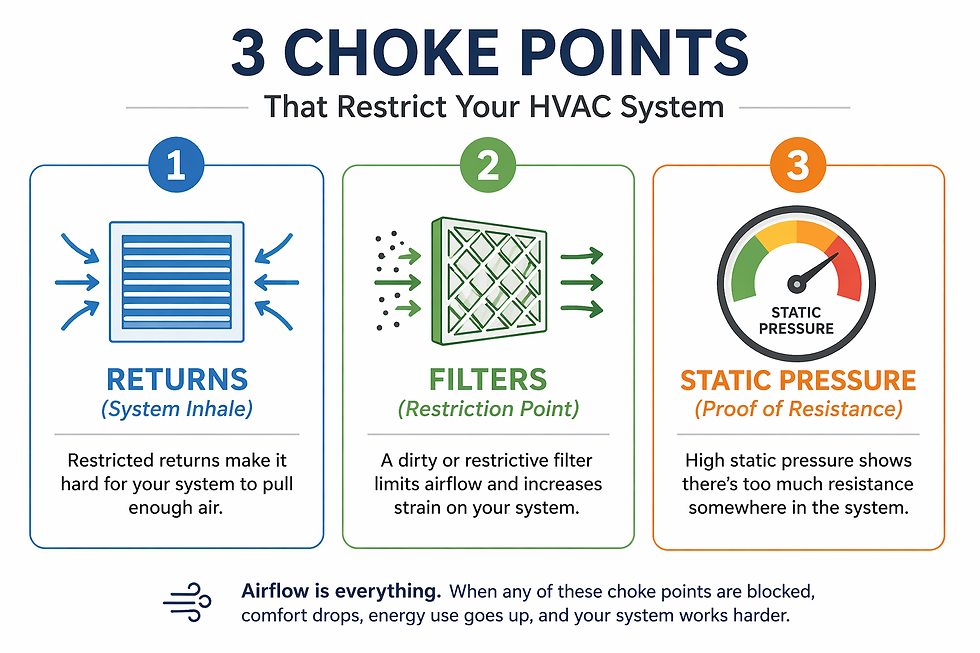
A) Return air problems
Returns are the system’s inhale. If return air is weak, everything suffers.
What causes return restriction
return grille blocked by furniture or curtains
return duct undersized for the system
not enough returns for the home layout
bedrooms with doors closed and no return path
return duct runs that are crushed or disconnected
Tacoma home reality
A lot of older homes have one central return. It can work, but it has limits. Once you add a remodeled basement, a bonus room, or tighter doors, return paths become a real issue.
Homeowner takeaway
Keep return grilles clear
If bedrooms feel stuffy with doors closed, return path is likely part of the issue
If a room gets better when the door is cracked open, that is a useful clue
B) Filter problems
Filters are essential. But filters can also be a choke point.
What causes filter restriction
filter is dirty
filter is the wrong size
filter is installed incorrectly
filter is too restrictive for the system and ductwork
A higher rated filter can be a great tool, but only if your system can move air through it properly.
Homeowner takeaway
Use the correct size so air cannot bypass it
Change it consistently
If you upgrade filtration and airflow gets worse, step back and have airflow checked
C) Static pressure problems
Static pressure is the measurement that tells the truth about restriction. You can think of it as the system’s resistance level.
High static pressure can cause:
loud returns
whistling vents
weak airflow to far rooms
increased blower stress
lower efficiency
High static pressure usually comes from a combination of:
restrictive filter
dirty coil or blower
undersized returns
ductwork sized too small for modern airflow needs
too many closed registers
Homeowner takeaway
If you are dealing with airflow problems, ask if the tech measured static pressure. If no one is measuring it, everyone is guessing.
What you can safely do at home first
This is the calm, practical part. Before you assume you need major work, do these simple checks.
1) Replace the filter and confirm it fits correctly
correct size
installed in the correct direction
not bent or collapsed
2) Clear every return grille
Make sure returns are not blocked by:
couches
rugs
curtains
bins
pet beds
3) Open all supply vents
Closing vents often increases duct pressure and makes airflow worse.
4) Check one simple bedroom test
If a bedroom is stuffy or uncomfortable at night:
try sleeping with the door cracked open one night
if the room improves noticeably, return path is likely part of the choke
5) Note the symptoms and when they happen
Good notes are powerful. Write down:
which rooms struggle
whether it is worse in heating or cooling
whether it is worse when it is damp outside
whether noise changes with a new filter
This turns “it feels off” into useful information.
What a good technician should do next if your system seems choked
A real diagnostic is not complicated, but it should be ordered correctly.
A good flow looks like:
confirm filter and return path basics
measure static pressure
verify airflow delivery and identify restrictions
inspect coil and blower cleanliness
inspect duct condition where accessible
then evaluate deeper system performance
If someone jumps straight to refrigerant checks or replacement recommendations without checking airflow and static pressure, they are skipping the foundation.
Red flags that you are not getting a real diagnosis
Watch for these:
“You just need a bigger unit” without airflow or static pressure checks
“Your system is old” as the main explanation
only checking refrigerant pressures and calling it done
not looking at the filter or return path
not asking which rooms are uncomfortable
not explaining what the numbers mean in plain English
recommending a high MERV filter as a cure-all
suggesting closing vents to solve uneven rooms
You do not need a tech to talk in circles. You need a tech to measure and explain.

A choked system is not a mystery. It has patterns.
If you have loud returns, weak airflow, whistling vents, uneven rooms, and longer runtime, you probably have restriction somewhere in the airflow path.
The fix is not guessing and it is not automatically replacing equipment. The fix is finding where the system is struggling to breathe, correcting it, and verifying improvement with measurements.
Most homeowners feel immediate relief once airflow is corrected because comfort becomes easier for the system, not harder.
If your system feels choked and you want a measured answer instead of a guess, GreenFlow Heating & Cooling can perform an airflow focused diagnostic that checks return capacity, filter impact, and static pressure so you know exactly what is limiting performance before anyone talks about bigger changes.


Comments